Best Ways to Declutter Your Home: A Step-by-Step Plan

Last Updated: October 22, 2026
Quick Summary
The best ways to declutter home start with a written plan: pick one visible goal, rank rooms by how much the clutter bothers you, and set a date for each room. Then work one zone at a time, sorting every item into keep, donate, discard, or relocate piles, and start with a small space rather than the garage.
- A full-house decluttering timeline runs four to eight weeks for most homes, weekends only.
- Grab four labeled bins for keep, donate, discard, and relocate before you touch anything.
- Set a 20-minute timer and stop when it rings, even if you are on a roll.
- If you cannot decide on an item in five seconds, put it in a dated box for six months.
- Do a ten-minute daily reset of one surface in one room before bed.
Table of Contents
- Start With a Plan: Set Goals and Pick Your First Room
- The Decluttering Checklist for Beginners
- A Decluttering Timeline for Your Entire House
- Work Room by Room: Closet, Garage, and Storage Areas
- How to Let Go of Sentimental and "Maybe" Items
- How to Dispose of Large Junk Items Responsibly
- Declutter With Family: Kids, Roommates, and Partners
- Maintain a Clutter-Free Home With a Simple Routine
- Frequently Asked Questions
Start With a Plan: Set Goals and Pick Your First Room
The best ways to declutter home start with one honest decision: what do you want back from your declutter home project? A garage you can park in, a closet that closes, a spare room that stops being a storage unit.
A decluttering plan is a written list of goals, rooms, and dates, it turns "someday" into a job with a finish line.
Here is how to build one in ten minutes:
- Pick one goal you can see, not feel. "Clear the garage floor" beats "be more organized."
- List your rooms and rank them by how much the clutter bothers you.
- Set a date for each room. One room per weekend is realistic for most people.
- Name your disposal plan before you start. Donation, recycling, trash, or a haul-away service.
Skip the goal-setting step and you will sort the same junk twice. The American Psychological Association's guidance on stress and clutter points out that clutter is linked to stress and poorer focus, which is why the goal matters as much as the sorting.
Choose a Starting Point and Begin Small
Start with the smallest space that still annoys you daily, a bathroom drawer, hall closet, or junk drawer. Finishing something small in under an hour builds momentum for the garage later.
Do not start with the garage. It is the room most likely to stall a first attempt.
The Decluttering Checklist for Beginners
A decluttering checklist for beginners lists what to grab, what to sort, and where each pile goes, removing the "where do I even start" problem.
Grab these before you touch anything:
- Four boxes or bins: keep, donate, discard, relocate
- Trash bags for obvious garbage
- A marker and tape for labeling bins
- A phone for photos of items you're unsure about
- Water and a snack
Then work one zone at a time. Clear a shelf, not a wall. Finish the shelf, then move on.
Sort Belongings Into Keep, Donate, Discard, and Relocate
Every item goes into one of four piles. No exceptions, and no "I'll decide later" pile, that pile is how clutter survives a session.
| Pile | What Goes In | Where It Ends Up |
|---|---|---|
| Keep | Used in the last year, or clearly needed | Back in place, with a home |
| Donate | Good condition, unused, useful to someone else | Local charity, shelter, or donation center |
| Discard | Broken, stained, expired, incomplete | Trash or recycling |
| Relocate | Belongs in another room or another person | Delivered that same day |
The relocate pile is the one people forget. A box of kitchen tools in the garage isn't clutter in the garage, it's clutter that hasn't moved yet.
A Decluttering Timeline for Your Entire House
A decluttering timeline for entire house projects runs four to eight weeks for most homes, weekends only. A plan with dates gets finished; one without dates becomes a hobby.
Build the timeline around what you can actually sustain:
- Week 1: Entryway, hall closet, junk drawer
- Week 2: Kitchen and pantry
- Week 3: Bedrooms and closets
- Week 4: Bathrooms and linen storage
- Week 5: Living areas and paperwork
- Week 6: Garage, shed, and yard
- Week 7: Donation drop-offs and haul-away booking
- Week 8: Final sweep and reset
Plans for Different Time Budgets
Time is why most plans die. Match the plan to the hours you actually have.
| Time Available | What to Tackle | Realistic Outcome |
|---|---|---|
| One weekend | One room, one zone at a time | A cleared garage bay or closet |
| One week of evenings | Two or three priority rooms | Visible progress in daily-use spaces |
| One month of weekends | Whole house except garage | House mostly done, garage scheduled |
| One day, no time at all | Book a haul-away and clear the worst room | Junk gone, sorting skipped |
That last row isn't a cop-out. If a room holds mostly broken furniture, old appliances, or renovation debris, sorting adds nothing, one-pass removal is faster.
Work Room by Room: Closet, Garage, and Storage Areas
Room-by-room work beats whole-house chaos because each space has its own rules: closets are about volume, garages about weight and bulk, and storage areas are where clutter goes to be forgotten.
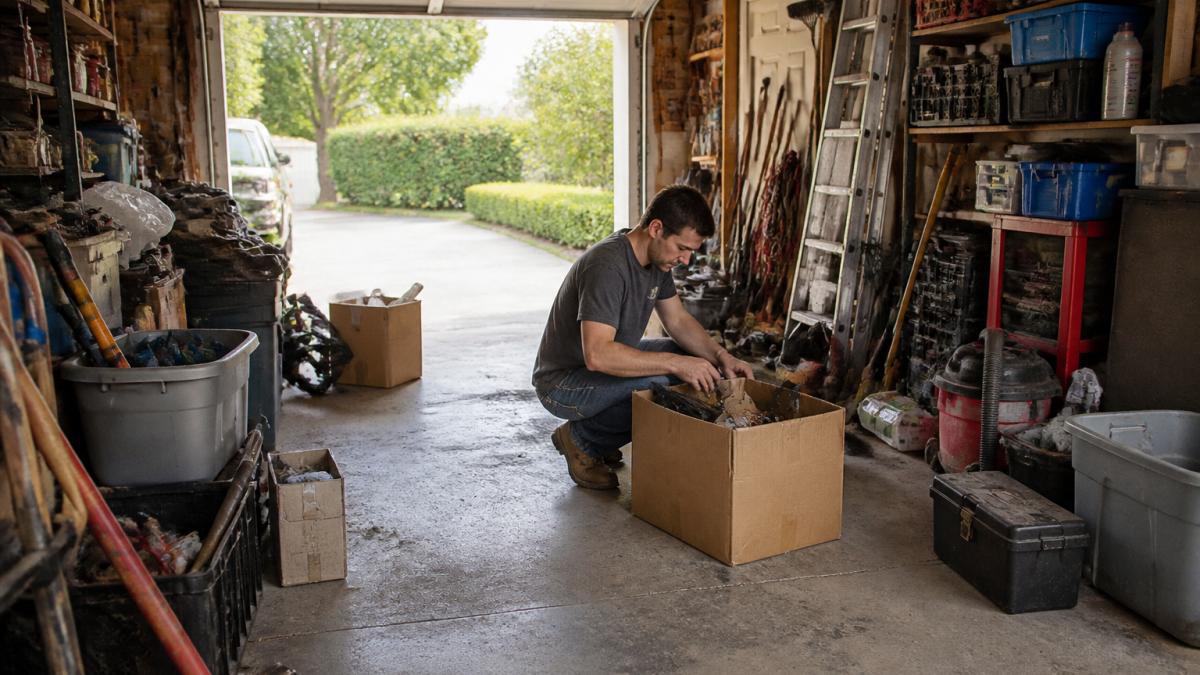
Start with the closet. Pull everything out, put back only what fits and what you wore this season. Seasonal items go into labeled bins on the top shelf.
Then the garage, where DIY decluttering usually stops because the items are heavy and awkward. JunkFree offers same and next-day haul availability with an up-front, on-site quote, so you know the number before anything leaves your property.
Storage areas come last. Clear surfaces first, then shelves, then the floor. A storage area with breathing room is one you will actually use.
How to Let Go of Sentimental and "Maybe" Items
Sentimental clutter is the hardest category, and it isn't really about the objects, it's the fear of losing the memory attached to them.
Try these rules:
- Keep the item that tells the story, not all twelve versions of it.
- Photograph bulky keepsakes, then let the object go.
- Ask "would I pay to store this?" If the answer is no, don't store it.
- Give keepsakes a home with a limit. One bin per family member, full stop.
- Hand items to the person who would actually use them.
The "maybe" items get a dated box, as covered above. Six months, then out. This one rule clears more clutter than any amount of willpower.
How to Dispose of Large Junk Items Responsibly
Knowing how to dispose of large junk items is the step most guides skip, and it decides whether your decluttering finishes.
Sort your large items into three streams, each with a different destination and set of rules.
Stream 1: Still usable. Furniture with intact frames and cushions, working appliances, tools, bicycles, and good building materials can often be donated.
A few practical rules speed up the process:
- Measure the door before you promise the donation. A couch that won't fit through the donor's front door becomes your problem again.
- Drain and dry appliances before pickup, and tape refrigerator doors shut.
- Bag mattress and upholstery debris if your hauler requires it, and never leave unwrapped mattresses at the curb in areas with mattress disposal ordinances.
- Keep donation receipts. Most charities provide them on request, and they are useful documentation if you itemize deductions.
- Ask the hauler where the load goes. A legitimate operation can tell you what it donates, what it recycles, and what it landfills. If the answer is vague, keep calling.
Never put hazardous waste, pressurized tanks, or lithium batteries in a rental dumpster or a curbside pile. They cause fires in collection trucks and landfills, and many states impose fines for improper disposal. Route them to a household hazardous waste site instead.
Photograph your donation drop-off receipt and your bulk pickup confirmation. It settles any doubt about where your stuff actually went, and it is useful if you itemize.
The environmental question is fair to ask.
Declutter With Family: Kids, Roommates, and Partners
Decluttering with other people fails for one reason: someone feels overruled.
The core rule is ownership: each person owns their belongings and the decisions about them.
With kids. Children form attachments fast and defend them hard, so give them control over what matters to them.
With roommates. Shared spaces need a written standard, not a vibe.
When someone won't participate. Declutter your own belongings and genuinely shared junk only, and never throw out someone else's things.
Give every household member a bin, a boundary, and a vote on shared items. The decluttering session that respects ownership is the one that actually gets finished, and the one that doesn't get undone the following week.
Maintain a Clutter-Free Home With a Simple Routine
A decluttered home stays that way through a routine, not willpower. The routine is small on purpose.
- Daily: ten minutes, one surface, one room. Reset it before bed.
- Weekly: one shelf or drawer, fully sorted.
- Monthly: one bin leaves the house, whether donated or hauled.
- Seasonally: swap seasonal items and check the dated "maybe" box.
- Annually: do a full walkthrough with the four-pile system.
The ten-minute daily reset is the one that matters. Clutter builds in small increments, so it clears the same way.
If the garage, yard, or storage areas keep refilling no matter what you do, that's a removal problem, not an organizing problem. JunkFree is a locally owned and operated family business, licensed and insured, offering flexible scheduling for residential and commercial needs and a clean sweep of the area before the crew leaves.
Frequently Asked Questions
What is the 20/20 rule for decluttering?
The 20/20 rule says that if you can replace an item for under $20 and in under 20 minutes, you can let it go. It works best on small duplicates: spare phone cables, extra spatulas, hotel toiletries. The point is to stop treating cheap, easily replaced objects as irreplaceable. Apply it during the sort phase of your decluttering checklist for beginners, and keep a short list of anything you genuinely use weekly so you do not toss a tool you rely on.
How do I start decluttering when I feel overwhelmed?
Pick one small, contained space: a single drawer, one shelf, or the floor of a closet. Set a 15-minute timer and sort only that spot into keep, donate, discard, and relocate piles. Finishing one small area gives you visible proof of progress, which reduces the decision fatigue that stalls most projects. Once that drawer is done, schedule the next session before you leave the room. Two or three short sessions a week beats one exhausting weekend.
What are the best ways to dispose of unwanted household items?
Start by separating usable items from true waste. Donate furniture, clothing, and working appliances to local charities, and check whether your municipality offers curbside bulk pickup for large items. Hazardous waste such as paint, batteries, and electronics needs a designated drop-off site, not the regular trash. For heavy loads like garage contents, estate clear-outs, or renovation debris, a licensed junk removal provider can haul everything in one visit and route usable goods to donation partners.
How can I maintain a decluttered home long-term?
Build a short daily routine: five minutes returning items to their designated bin or shelf, plus one weekly 15-minute reset of the busiest room. Use the one-in, one-out rule for clothes, tools, and kitchen gear so storage does not creep back to capacity. Clear surfaces once a week and keep a donation box in the garage or closet that leaves the house as soon as it fills. A home inventory list of what you actually store helps you spot duplicates before you buy them again.
Decluttering stalls when the sorting is done but the junk is still sitting there. JunkFree handles that last step with same and next-day haul availability, up-front on-site quotes by weight and item, and a real commitment to donating and recycling usable items through local partners. Our licensed and insured crew clears the room and sweeps up before leaving. Get started with JunkFree and finish the job you already started.
Got junk? We'll clear it.
Family owned in Fallbrook, serving all of North County San Diego. Book online or get a free, no-pressure quote.